English Wheel Buying Guide: How to Pick the Right Wheel for Metal Shaping
An English wheel is the traditional hand tool for shaping flat sheet metal into compound curves — the kind of double-curved surfaces you see on car body panels, aircraft skin, motorcycle tanks, and hand-formed custom parts. Unlike stamping dies (which need a factory to make one specific part), an English wheel is a general-purpose shaping tool that any small shop can use to make almost any curved panel, one piece at a time.
This guide walks through everything you need to know before buying an English wheel — how it works, the four specs that actually matter (throat depth, gauge capacity, mount type, input power), and side-by-side recommendations for every English wheel we stock at Pittsburgh Spray Equipment. If you're ready to browse the full lineup, jump straight to our English Wheels collection.
How an English Wheel Works
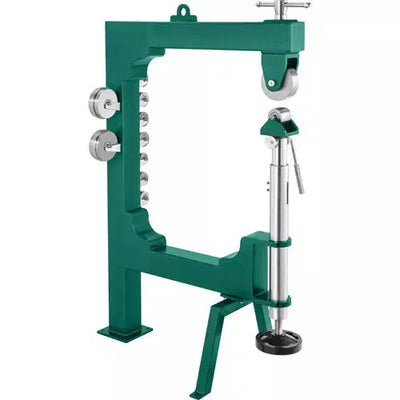
An English wheel has two shaped wheels — a large top wheel and a smaller anvil (bottom) wheel — mounted on a rigid steel frame. You feed a piece of sheet metal between them and roll it back and forth under pressure. Each pass slightly stretches the metal along one axis, creating a curve. Change directions and you create curves along the other axis. Do both and you get a compound curve — the shape you can't make with any other single tool.
The bottom anvil comes in a range of interchangeable radii (from flat to a tight 4" crown). A flatter anvil produces gentle curves; a more crowned anvil produces tighter curves. Most floor-model English wheels ship with a set of 6-8 anvils covering the common range.
What to Look For — The Four Specs That Matter
1. Throat Depth
Throat depth is the distance from the anvil wheel to the frame. It defines how far into a panel you can reach — so it caps the maximum panel size you can shape. Match throat depth to your largest planned panel:
- Under 20" — hobbyist parts, motorcycle tanks, small fender flares, cowls. The Grizzly T25101 (15" benchtop) is the classic entry-level wheel at this range.
- 20-25" — half-panels, hood scoops, larger fender sections. The Grizzly T28964 (22" benchtop) is the sweet spot for restoration shops on a budget.
- 26-30" — full automotive quarter-panels and most body work. Baileigh's 28" and EW-30 floor models fit here.
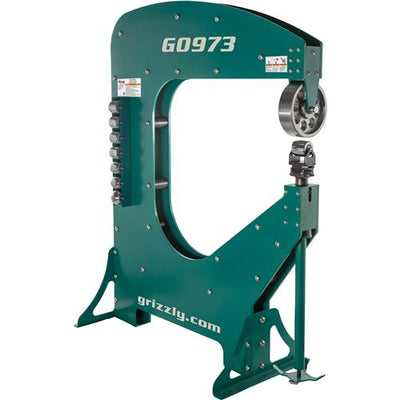
- 31-40" — full doors, hoods, larger sheet panels. The Grizzly T27621 (32" Professional) is a solid pick, and the Grizzly G0973 (40" Heavy-Duty Industrial) handles the largest panels most shops encounter.
- Over 40" — aircraft skin, motorsport bodies, and full-size restoration shops. The Baileigh EW-45 (45") is our largest English wheel.
Buy for the biggest panel you'll actually shape, not the average. You cannot work around a too-small throat — if the panel is 30" wide and your wheel is 24", you simply can't reach the middle. Going bigger costs more but adds capability.
2. Steel Gauge Capacity
Rated gauge tells you the thickest mild-steel sheet the wheel can shape without stalling or flexing the frame. Lower gauge number = thicker steel.
- 20 Ga (0.036") — light shaping, aluminum, and thin mild steel. Best for hobby and prototyping.
- 18 Ga (0.048") — standard automotive body panels. The everyday workhorse gauge for restoration work.
- 16 Ga (0.060") — heavier auto body and light structural work.
- 14 Ga (0.075") and thicker — professional bodyshop, aircraft, and industrial work. Baileigh's EW-30, EW-37, and EW-45 are all rated to 14 Ga.
A quick reality check: lighter-rated wheels can't be pushed past their spec. If you try to run 16 Ga steel through a 20 Ga hobby wheel, the frame will flex, the material will stall, and you'll get inconsistent shaping — no matter how hard you crank. If you're doing regular auto body work, plan for at least 18 Ga capacity; for restoration on older heavy-gauge cars, go 16 Ga or 14 Ga.
3. Bench Top vs. Floor Model
Bench-top English wheels mount to a sturdy workbench. They're ideal for small-shop and hobbyist users where floor space is limited, and typically max out at 22-24" throat depth. Examples: the Grizzly T25101, T28964, and Baileigh EW-21.
Floor-standing English wheels come with their own steel frame stand. Two big advantages: (1) the frame is much more rigid, giving you consistent shaping on large panels without flex; (2) they free up your bench for other work and are easier on your back for long shaping sessions. Any wheel with a throat depth 24" or greater in our lineup is a floor model.
Recommendation: if you're setting up a dedicated shaping station and have the floor space, go floor. If your English wheel is one of many tools sharing bench space, benchtop is fine — just don't buy a bench-top unit and expect it to shape panels bigger than its rated capacity.
4. Input Power
Every English wheel in our current lineup is manually operated — you spin the anvil wheel by hand while moving the panel between the wheels. Manual operation gives the operator maximum control over material feed rate and pressure, which is why traditional English wheels remain the standard for finish body work.
Motorized English wheels exist but are almost exclusively used in production settings where the same part is shaped repeatedly. For custom, restoration, or hobbyist work, manual is the right answer.
Model Recommendations by Use Case
Hobbyist / occasional use — under $300
The Grizzly T25101 15" Benchtop English Wheel is the cheapest way to get a real English wheel in your shop. Great for small parts, hobbyist tank work, and learning the technique. Not suitable for real auto body panels.
Small restoration shop / weekend body work — $500-1,000
The Grizzly T28964 22" Heavy-Duty Benchtop at $600 is the best price-to-capability English wheel we sell. 22" throat handles half-panels and most fender work, 18 Ga capacity covers most body panels, benchtop mount saves floor space.
Full restoration shop / regular auto body — $3,000-4,000
The Grizzly T27621 32" Professional English Wheel at $3,200 or the Grizzly G0973 40" Heavy-Duty Industrial at $4,050 gives you full-panel capacity and floor-mounted rigidity. The T27621 fits most shops; go G0973 if you regularly work on doors, hoods, and full quarter-panels.
Professional bodyshop / aircraft work / heavy 14 Ga — $8,000+
The Baileigh EW-30, EW-37, and EW-45 are our top-tier professional wheels — 14 Ga steel capacity, massive frames that don't flex, and the largest anvil sets. If you're a working restoration or fabrication business, the extra rigidity pays for itself in consistency and speed.
Frequently Asked Questions
Do I need different anvil wheels for different curves?
Yes — the anvil (bottom) wheel comes in different crown radii. A flatter anvil produces gentler curves; a more crowned anvil produces tighter curves. Most floor-model English wheels ship with a set of 6-8 anvils covering the common radius range. Bench-top units usually ship with fewer anvils but accept aftermarket sets.
Can I use an English wheel on aluminum?
Yes — English wheels work well on aluminum, and the same wheel typically handles thinner aluminum than steel. An 18 Ga steel-rated wheel usually handles 16 Ga aluminum comfortably. Aluminum work-hardens as you shape it, so use gentler passes and anneal between passes for tight curves.
Can I use an English wheel on stainless steel?
Yes, but drop your gauge capacity rating by one step. A wheel rated for 18 Ga mild steel handles about 20 Ga stainless. Stainless is significantly harder than mild steel and puts more stress on the frame — don't push a wheel past its de-rated stainless capacity.
How much space do I need around an English wheel?
For any panel work, you need at least the throat depth of your wheel PLUS 3-4 feet on each side to freely move the panel. A 30" throat wheel needs roughly 8-9 feet of clear working space. Plan the floor layout before you buy.
What's the difference between Baileigh and Grizzly English wheels?
Grizzly generally wins on entry-level price — their T25101 is the cheapest way to get a real English wheel. Baileigh wins on heavy-duty capacity and finish quality — the EW-30 / EW-37 / EW-45 are 14 Ga rated with much heavier frames, larger anvil sets, and are the choice for professional bodyshops. Both carry full manufacturer warranties, both are sold and supported by Pittsburgh Spray Equipment.
Do you offer installation or training?
We ship the wheels — installation is straightforward (bolt bench-tops to your bench; floor models are shipped assembled with their stand). For technique, we recommend Baileigh's video library (free English wheel tutorials on YouTube) and the classic Sheet Metal Handbook by Ron Fournier. Our tech team is happy to answer setup and spec questions at 888-714-1410.
Ready to Buy?
Browse our full English Wheels collection — 10 machines from Baileigh Industrial and Grizzly, filtered by throat depth, gauge capacity, mount type, and input power. Every wheel ships direct from the manufacturer with full warranty. Financing available at checkout on qualifying orders.
Questions? Call us at 888-714-1410 or email sales@pittsburghsprayequip.com — Mon-Fri 8:30 AM - 5:00 PM ET. Our team has been sizing metal-forming equipment for Pennsylvania and nationwide customers for 60+ years.