FREE Shipping On Order Over $500

Collection: Paint Pressure Pots

About Paint Pressure Pots · Learn More ▾

Authorized Paint dealer. Shop the full line of paint pressure pots at Pittsburgh Spray Equipment — 193 in-stock products including complete units, kits, and OEM parts. Ships direct from the manufacturer. Not sure which model fits your work? Call 800-245-0267 or email sales for real technical help.

Why buy from Pittsburgh Spray Equipment
  • Authorized dealer — full manufacturer warranty and real support
  • Ships factory direct — no shelf inventory sitting for years
  • Tech support that answers — call 800-245-0267 or email sales, no phone tree
  • Financing available — Credit Key + Klarna at checkout on qualifying orders
  • 60+ years serving the finishing industry — Pittsburgh-based, family-owned

Shop paint pressure pots and paint pressure tanks from Binks, C.A. Technologies, Graco, DeVilbiss, and Apollo — in 2, 2.5, 2.8, 5, 10, 15, 30, and 60 gallon sizes, with stainless steel, galvanized carbon steel, and zinc-lined tanks. Single- and double-regulator models, ASME‑rated and non‑ASME options, standard and gear-reduced agitator versions all in stock. Same or next-day shipping from Pittsburgh, PA.

📖 Learn about paint pressure pots — why use one, how to choose size/material/regulator, and FAQ

Complete walkthrough: setting up and spraying with a pressure pot & HVLP gun (252,000+ views on our YouTube channel).

Why use a paint pressure pot?

A paint pressure pot (also called a paint pressure tank) lets you spray large volumes of finish without stopping to refill a cup, and it gives you finer atomization at lower air pressure than a gravity or siphon cup can deliver. For anyone spraying more than a quart of material at a time — cabinet shops, industrial coating lines, autobody, furniture, sign shops, marine, aerospace — a pressure pot is the right tool.

  • Continuous spraying — 2 to 60 gallons of material feed straight to the gun; no cup swaps.
  • Better atomization at lower CFM — feeds paint by regulated air pressure instead of relying on gun venturi, so you get a finer, more even fan.
  • Spray any orientation — upside-down, sideways, into deep recesses; pressure feed doesn't depend on gravity.
  • Handles heavier materials — primers, gel coats, texture coatings, and high-solids finishes that clog gravity guns.
  • Faster color changes & cleanup — on multi-liner tanks (5 gal. pail insert, 1 gal. pail insert) you swap the liner instead of scrubbing the tank.

How to choose the right paint pressure pot

  1. Tank size (capacity)
    • 2 & 2.8 gallon — small jobs, sample work, mobile spraying, tight spaces.
    • 5 gallon — the most common shop size; fits a standard 5 gal. paint pail with a liner.
    • 10 & 15 gallon — full-shift production runs, cabinet shops, industrial coating lines.
    • 30 & 60 gallon — large industrial / OEM lines with multiple guns off one tank.
  2. Tank material & lining
    • Stainless steel — best for waterborne coatings, acids, and mixed-solvent shops; no corrosion, easiest to clean.
    • Galvanized / zinc-plated carbon steel — economical, ideal for solvent-based finishes; won't rust with normal use.
    • Bottom-outlet vs top-outlet — bottom outlets drain the tank fully (better for high-solids); top outlets are simpler and cleaner for standard finishes.
  3. Regulator setup
    • Single regulator — one gauge controls tank (fluid) pressure; simpler, lower cost.
    • Double regulator — separate controls for fluid pressure and gun atomizing air; essential for fine-finish work where you need to trim atomizing air independently.
    • Non-regulator — feeds directly off shop air; good for texture and industrial pumps that don't need trim.
  4. Agitator
    • Non-agitated — standard for finishes that stay in suspension (most lacquers, water-based clears).
    • Standard agitator — for finishes that settle (metallic basecoats, some primers).
    • Gear-reduced agitator — heavy materials (industrial primers, texture, high-metallic content); slower & higher-torque than standard.
  5. ASME certification — ASME-stamped tanks are required by many industrial and commercial insurance carriers, and by OSHA in some workplaces. Confirm your facility's requirements before ordering.
  6. Compatibility with your spray gun — pressure pots pair with pressure-feed spray guns (not gravity or siphon). Match the hose fittings and check the recommended fluid pressure range for your gun/tip combination.

Need help matching a pot to your job? Call us at (888) 714‑1410 — we'll spec the whole outfit (pot, gun, hoses, fittings) so it works out of the box.

Shop by category

By brand: Binks · C.A. Technologies · Graco · DeVilbiss · Apollo

By size: 2.8-Gallon Outfits · 5-Gallon

Related: Pressure-Fed Spray Guns · Adhesive Spray Outfits · Pressure Pot Buyer's Guide (blog) · Troubleshooting Guide

Frequently asked questions

What size paint pressure pot do I need?
Match tank size to the volume you spray between refills. Under 1 gallon per shift → a 2 or 2.8 gallon tank is plenty. Cabinet shops and general production work → 5 gallon (the most popular shop size, and it accepts standard 5 gal. paint pails with a liner). Industrial coating lines running all shift → 10, 15, or 30 gallon.

Do I need an ASME-stamped pressure pot?
Many commercial and industrial facilities require ASME-stamped tanks for insurance and OSHA compliance. For home or garage use it's usually optional. Check with your safety officer or insurer before you order.

What's the difference between a single- and double-regulator pressure pot?
A single regulator controls only tank (fluid) pressure — simpler and cheaper, good for straight production runs. A double regulator controls fluid pressure and gun atomizing air separately, which is essential for fine-finish work where you need to trim atomizing air without changing fluid delivery.

Can I use my regular HVLP or conventional spray gun with a pressure pot?
Only if it's a pressure-feed gun. Gravity and siphon guns won't work — they rely on cup vacuum or gravity to move fluid. Any of the guns in our pressure-fed spray guns collection pair correctly with a pot.

Stainless steel or galvanized carbon steel — which tank?
Stainless is best for waterborne coatings, acids, and shops that switch between different finish chemistries — it won't corrode and cleans up easier. Galvanized/zinc carbon steel is more economical and works well for straight solvent-based shops that don't spray waterborne.

What does an agitator do and do I need one?
Agitators keep pigments and heavy solids suspended in the paint so they don't settle to the bottom of the tank. You need one for metallic basecoats, high-solids primers, texture coatings, and any finish that settles when it sits. You can skip it for clear lacquers, most single-stage acrylics, and thin waterborne clears.

3 products
Clear all
Price
Brand
Paint Pressure Pot Size
Capacity (Gallons)
  • Devilbiss KK-4977 Diaphragm HAR - Repair Kit
    Devilbiss kk-4977
    Regular price
    $85.99
    Sale price
    $85.99
  • Devilbiss KB Two-Quart Pressure Cup KB-555 Aluminum (Tank only)
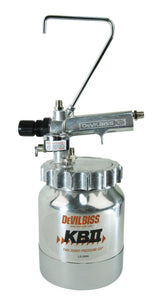
    Devilbiss  KB Two-Quart Pressure Cup KB-555 Aluminum (Tank only)
    Regular price
    $451.00
    Sale price
    $451.00
  • Devilbiss Lid Gasket (5, 10, 15 Gal)
    Devilbiss Lid Gasket (5, 10, 15 Gal) (1587370754083)
    Regular price
    $91.00
    Sale price
    $91.00
Added to cart View Cart


Net Orders Checkout

Item Price Qty Total
Subtotal $0.00
Shipping
Total

Shipping Address

Shipping Methods