
Collection: Tumble Blast Cabinets
About Tumble Blast Cabinets · Sizing Guide · FAQ ▾
Tumble blast cabinets do the one job a hand cabinet cannot: process a whole batch of parts without an operator turning each piece to reach the back of it. You load the basket or barrel, set a timer and walk away, and the machine cleans, deburrs, shot peens or finishes the entire load while it rotates. For any shop running repeat batches of small or medium hard parts, that is the difference between a job that ties up a person all afternoon and one that runs itself. Questions on sizing? Call 888-714-1410.
How tumble blasting works
The load rotates inside a perforated basket or a rubber-lined barrel while automatic blast guns fire into it. Media falls through the perforations, gets separated from dust and spent abrasive in a reclaimer, and returns to the guns. Because the parts are constantly presenting new faces to the guns, coverage is even in a way that hand blasting rarely matches — and because the load rides on a bed of media rather than bare steel, parts come out finished rather than battered.
Choose by batch weight
| Machine | Batch limit | Chamber | Media handling | Power | Price |
|---|---|---|---|---|---|
| Clemco DCM-161 | 25 lbs | 2 gal basket | dust bag, no reclaimer | 115V 1ph | $6,155 |
| Clemco BNP-160 | 25 lbs | 2 gal basket | 100 cfm reclaimer + reverse pulse | 115V 1ph | $12,875 |
| Clemco 4-Gallon | 35 lbs | 4 gal basket | 300 cfm reclaimer + reverse pulse | 115V 1ph | $27,935 |
| Clemco BNP 162 | 100 lbs | 1.0 cuft barrel | 600 cfm LPDC or RPH | 230/460V 3ph | from $37,935 |
| Clemco BNP 164 | 200 lbs | 2.0 cuft barrel | 600 or 900 cfm LPDC or RPH | 230/460V 3ph | from $40,605 |
| Clemco BNP 166 | 300 lbs | 3.0 cuft barrel | 900 cfm LPDC or RPH | 230/460V 3ph | from $49,630 |
This collection also carries Trinco and Cyclone tumble blasters, which cover the lighter and more occasional end of the range.
Baskets versus barrels
Baskets top out at 35 lbs and run on single-phase power, which makes them practical for an automotive shop or a small parts manufacturer that wants automation without an electrical project. Barrels start at 100 lbs, need three-phase, and are the right answer once blasting is a production step rather than an occasional chore. The gap between the 4-gallon basket at 35 lbs and the BNP 162 at 100 lbs is real — if your batches land in between, call us rather than guessing.
Why buy from Pittsburgh Spray Equipment
- We will size the machine against your actual part, batch weight and duty cycle before you order — including telling you when the cheaper machine is the right one.
- Media selection advice, which matters more on tumble work than on hand blasting: the wrong media will either take forever or round your edges.
- Financing available on the barrel machines.
- Wear parts, barrel assemblies, liners and replacement baskets stocked, so a machine bought here stays running.
- Shot peening support — tell us the Almen intensity you need and we will confirm the media and pressure with you.
FAQ
What is the difference between a tumble basket and a tumble barrel?
A basket is a perforated drum that holds a couple of gallons and rotates under one or two fixed guns — right for hardware, fasteners, brake parts and other small pieces in 25–35 lb batches. A barrel is a much larger rubber-lined drum with two to six guns firing into it, taking 100–300 lbs. The dividing line is roughly 35 lbs a batch: above that you want a barrel.
How do I work out the batch weight I need?
Weigh one part, then decide how many you want to process per cycle and how many cycles per shift you are willing to run. A cycle is typically 10–20 minutes. If the arithmetic says you need more than about three cycles an hour to keep up, size up rather than run the smaller machine flat out — duty cycle, not capacity, is what kills these machines early.
Will tumbling damage my parts?
Inside a barrel the load rides on a cushioning bed of media rather than on bare steel, and on the Clemco 4-gallon basket the front-facing opening makes parts cascade forward instead of dropping. Both are there to limit part-on-part impingement. Thin, soft, finished or already-machined parts still need care — variable-speed barrel drive lets you slow the tumble, which is the main control you have.
Do I need three-phase power?
Not for the small machines. The DCM-161, the BNP-160 and the 4-gallon basket all run on ordinary 115V single-phase. Every tumble barrel — the 162, 164 and 166 — needs three phase, either 230V or 460V. If you only have single-phase service, the basket machines are your ceiling unless you add a phase converter.
What is the difference between the RPH and LPDC dust collectors?
Both pull the same airflow for a given rating. The RPH has a tall built-in hopper: dust pulses down into the hopper and then into a drum or bag underneath, so nobody handles it, and it can be installed outdoors. The LPDC trades that height for a shorter package that fits under a lower ceiling. Measure your headroom before choosing — that is usually what decides it.
Can I shot peen in a tumble cabinet?
Yes, and it is one of the main reasons shops buy them. Springs, journals, bearings, valve stems and tooling all get peened this way to improve fatigue life. Peening intensity depends on media, pressure and dwell, so tell us the Almen spec you are working to and we will confirm the machine and media together.
Does the machine clean and reuse the blast media?
Most of them do. Every Clemco tumble cabinet here except the DCM-161 includes a reclaimer that separates reusable media from spent media and dust and returns the good media to the gun. The DCM-161 is a dust-bag machine with no reclaimer — fine for occasional batches, but the media consumption adds up quickly under daily production.
-
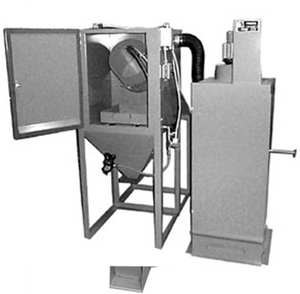
Trinco Tumble Blaster 14x12 w/ 400 CFM Pull thru Dust Collect

- Regular price
- $9,375.00
- Sale price
- $9,375.00


